{"ops":[{"insert":"The Bundestag is the first chamber of the German parliament. The 21st Bundestag has been constituted since March 25. It is made up of 630 members of parliament and is responsible for legislation, among other things. Julia Klöckner (CDU/CSU) is the current President of the Bundestag.\n"}]}
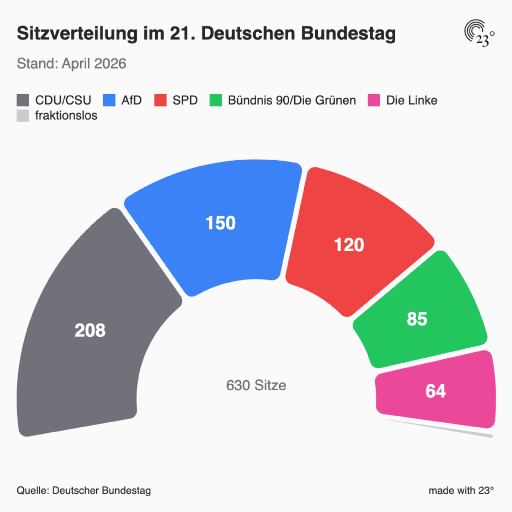
Current distribution of seats in the Bundestag
The Bundestag is currently made up of MPs from seven parties: The CDU/CSU Union forms the largest parliamentary group. The AfD, SPD, Alliance 90/The Greens and the Left Party are also represented as parliamentary groups in the Bundestag. Apart from the parliamentary groups, there is one member of the SSW (non-attached) and one non-attached member. Together with the SPD, the CDU and CSU form the current German federal government.
The composition of the Bundestag corresponds to the proportion of second votes cast for the parties. To enter the Bundestag, a party must achieve five percent of the second votes in the entire federal territory in order to participate in the distribution of seats. National minorities and parties that have won at least three direct mandates are exempt from this blocking clause.
In the 2025 Bundestag election, the CDU achieved around 27% of the second votes cast. The AfD came in second place for the first time with around 21% of the vote. Around 16% voted for the SPD, around 12% for the Greens and around 9% for the Left Party. The FDP and the BSW failed to reach the five percent hurdle and did not make it into the Bundestag.
Who sits in the Bundestag?
The current members of the Bundestag were around 47 years old at the start of the legislative period in 2025. This is the youngest Bundestag since 1972.
The proportion of women in the Bundestag is currently around one third. Women are underrepresented in the Bundestag: They make up around 51% of the population. In the past, the proportion of women was already higher. The fact that it has now fallen again is partly due to the rise of the CDU/CSU and the AfD. At 23.1% and 11.8% respectively, these two parties have a low proportion of women in their parliamentary groups. The Greens and the Left have a share of women of 61.2% and 56.2% respectively. Although the CDU decided on a quota for its list places in 2022, proportionally fewer women entered the Bundestag than in previous elections. This is because the party wins most of its seats via direct constituency mandates.
People with a migration background are also underrepresented in the Bundestag compared to their proportion in the overall German population. According to Mediendienst Migration, around 30 percent of the total population has a migration background. In the Bundestag, the proportion of people with a migration background is around 11.6%.
Members of the Bundestag receive a gross monthly allowance of 11,833 euros and a net expense allowance of 5,467 euros
The remuneration for members of the German Bundestag has been €11,833.47 per month since July 1, 2025. It is adjusted annually based on the development of the nominal wage index determined by the Federal Statistical Office. Members of the Bundestag also receive a tax-free lump-sum expense allowance as part of the official allowance. This has amounted to €5,467.27 per month since January 2026. Members of the Bundestag must use the expense allowance to cover all expenses incurred in the exercise of their mandate. This includes expenses for setting up and maintaining one or more constituency offices, travel in the constituency and constituency support. If a Member of the Bundestag has a second home in Berlin, the costs for this must also be paid for with the expense allowance.
Bundestag election 2029: Union leads in Sunday poll
If the Bundestag is not dissolved before then, the next general election will take place on January 28 at the earliest and March 25, 2029 at the latest. In polls conducted by Infratest dimap, the CDU/CSU is currently in first place. The AfD is close behind.
FAQs
Ein Bundestagsabgeordneter verdient 11.833 Euro (ab 1. Juli 2026 12.330 Euro) brutto und 5.467 Euro Aufwandspauschale netto. Die Aufwandspauschale ist für alle Ausgaben, die zur Ausübung des Mandates anfallen, bestimmt. Dazu zählen Ausgaben für die Einrichtung und Unterhaltung eines oder mehrerer Wahlkreisbüros, Fahrten im Wahlkreis und die Wahlkreisbetreuung. Hat ein Bundestagsabgeordneter oder eine Bundestagsabgeordnete hat eine Zweitwohnung in Berlin, müssen die Kosten dafür ebenfalls mit der Aufwandspauschale beglichen werden.
Nach der Bundestagswahl 2025 betrug der Anteil der AfD im Bundestag 24,1 Prozent. Die AfD stellte 152 der 630 Abgeordneten im Bundestag. Mittlerweile sind zwei der ursprünglichen AfD-Abgeordneten fraktionslos.
Bis zur Wahlrechtsreform im Jahr 2023 wurden zusätzlich zu jenen Sitzen, die durch die Zweitstimmen vergeben wurden, noch etwaige Überhang- und Ausgleichsmandate vergeben. Durch die Wahlrechtsreform wurde die Zahl der Abgeordneten auf 630 begrenzt. Die Überhang- und Ausgleichsmandate entfallen seitdem. Zuvor hatte der Bundestag eine Größe von 733 Abgeordneten erreicht.
Der Bundestag setzt sich aktuell aus 208 Abgeordneten der Parteien CDU/CSU, 150 Abgeordneten der AfD, 120 Abgeordneten der SPD, 85 Abgeordneten der Grünen, 64 Abgeordneten der Linken, zwei parteilosen Abgeordneten und einem Abgeordneten des SSW zusammen.
Beim SSW handelt es sich um den Südschleswigschen Wählerverband. Als Partei der dänischen Minderheit ist er, ebenso wie andere Parteien nationaler Minderheiten, von der Fünf-Prozent-Hürde befreit. Bei der Bundestagswahl 2025 erhielt der SSW 0,15 Prozent der Zweitstimmen.
Der Bundestag ist das aktuelle, gewählte Parlament der Bundesrepublik Deutschland. Das Reichstagsgebäude in Berlin, in dem der Bundestag tagt, wird umgangssprachlich als Reichstag bezeichnet. Historisch war der Reichstag das Parlament des Deutschen Kaiserreichs (1871-1918) und der Weimarer Republik (1919-1933).
Abgeordnete einer Partei können sich nur dann zu einer Fraktion zusammenschließen, wenn sie mindestens fünf Prozent aller Parlamentarier ausmachen. Erreichte eine Partei diese Grenze nicht, bleiben die Abgeordneten fraktionslos. Abgeordnete können auch fraktionslos werden, wenn sie aus ihrer Fraktion ausgeschlossen werden oder austreten.
Wird der Bundestag davor nicht aufgelöst, findet alle vier Jahre eine Bundestagswahl statt. Die nächste Bundestagswahl findet spätestens am 25. März 2029 statt.
Deutscher Bundestag: https://www.bundestag.de/services/glossar/glossar/B/bundestag-245362
Deutscher Bundestag: https://www.bundestag.de/services/glossar/glossar/S/sitzverteilung-441992
Deutscher Bundestag: https://www.bundestag.de/services/glossar/glossar/F/fuenfprozenthuerde-857038
Deutscher Bundestag: https://www.bundestag.de/services/faq/arbeit-244948
Deutscher Bundestag: https://www.bundestag.de/services/faq/abgeordnete-244894
Mediendienst Integration: https://mediendienst-integration.de/news/73-abgeordnete-mit-migrationshintergrund/
Tagesschau: https://www.tagesschau.de/inland/bundestagswahl/startseite/frauen-im-bundestag-100.html